
Placenta Burial Ceremony

Ai mention: just for the reader to be aware, the english of this article was corrected thanks to Ai, except the parts written in orange, though it was thought and put together by a real human, myself! Hope you'll enjoy and be inspired by this article, feel free to share, and please comment, let me know what you thought about it, I would really appreciate it!
There are moments in life that feel so ancient, so instinctive, that they seem to belong both to us and to all the women who came before us. Pregnancy is one of them. Birth is one of them. And perhaps, quietly, the burial of the placenta is one too.
In many ancient cultures, the placenta was never considered “medical waste.” It was honored as something sacred: an organ created solely for the purpose of nourishing life. A temporary bridge between worlds. Between mother and baby. Between heaven and earth.
What is less known is that Jewish tradition also contains references to the respectful burial of the placenta.
In the article How Ritual Placenta Burial Helped Me Seed New Connections published by the Jewish Women’s Archive, the author references the Yerushalmi (Jerusalem Talmud), which mentions the custom of burying the placenta “to serve as collateral for the earth.”This teaching is also cited in the Mishna Berura (330:24).
The symbolism feels deeply connected to Jewish thought itself. In the Torah, human beings are compared to trees: “Ki ha’adam etz hasadeh” - “For man is like the tree of the field” Devarim (Deuteronomy) 20:19
The placenta itself resembles a tree: branching veins like roots, carrying nourishment silently and continuously throughout pregnancy. During nine months, it becomes the baby’s first source of life in this world.
And then, once its sacred mission is complete, it returns to the earth.
The article also references the ancient Jewish understanding that burial itself reflects the natural return of creation back to creation — echoing the verse in Bereishit: “For dust you are, and to dust you shall return.” Bereishit (Genesis) 3:19
For many families, the placenta burial ceremony becomes a meaningful way to honor birth, motherhood, the body, and the transition into a new stage of life. Some choose to plant a tree above the placenta, transforming the burial into a living symbol of rootedness, continuity, and growth.
In Judaism, burial itself is deeply holy because returning something to the earth acknowledges that creation belongs to Hashem. The cycle continues. Nothing is truly separate.
For me, the placenta burial ceremony became a way to consciously mark the passage from pregnancy into motherhood. A way to honor my body, the miracle of creation, and the invisible wisdom woven into birth itself.
The ceremony can be done privately, with family, or in community. Some choose to plant a tree above the placenta, symbolizing the child’s growth and rootedness in life. Others accompany it with prayers, songs, or a "Seudat Hodayah," a meal of gratitude.
Here is the ceremony I created and performed, make it your own, be creative, do something that feels right to you, infused by our magical Jewish wisdom and traditions...
Preparing the Space
The ceremony may begin with a quiet moment of reflection, music, or the viewing of meaningful photos or videos from the pregnancy or birth journey.
A tree is then chosen as the place where the placenta will be buried. In this case, it can be a young tree or an already existing tree in the garden, such as a fruit tree, carrying the symbolism of life, nourishment, and continuity.
The earth is prepared by digging a deep enough hole to ensure both respect for the process and protection from animals or natural disturbances. The placenta is then placed in the earth with intention and care.
Many families choose to enrich the soil as part of the ritual, adding natural compost such as vegetable peels, eggshells, and dried flowers. This becomes a symbolic offering of nourishment, allowing the burial to also become a gesture of giving back to the earth that sustains all life.
After placing the placenta, the earth is gently covered, and some choose to place stones on top as an additional layer of protection and as a marker for the space. This also allows the area to be identified later for watering or tending the tree.
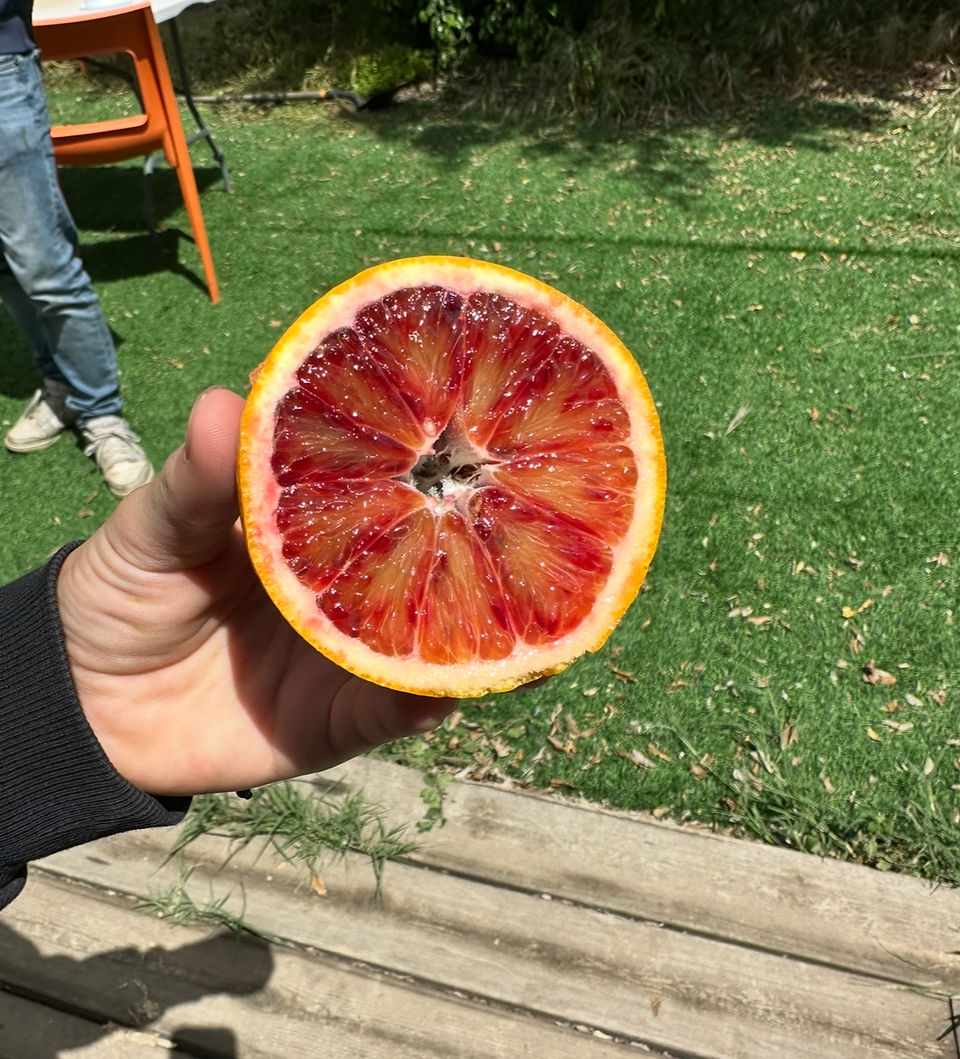
In this particular ceremony, the burial took place at the foot of an already existing tree, a blood orange tree growing in a home garden. The choice of a fruit-bearing tree adds another layer of symbolism: life, sweetness, and the ongoing cycle of nourishment between earth, tree, and family.
Burial of the Placenta
“Dear Earth, here is the placenta that my body created to nourish our [baby’s name] until her birth, which was in this place. As per the Jewish tradition of our ancestors, Hashem, we thank you and bury this placenta at the foot of this tree, in the earth where our beloved baby, this soul that you entrusted to us and that makes us a family, was born on the 29th of Shevat, 5786.”
“My dear [baby’s name], know that our bond will always remain as strong as it was with this placenta, even stronger, because it is infinite. Throughout our lives, and even beyond, we will discover together all the forms of this infinite bond. But like that powerful moment when the cord was cut, little by little you are gaining your independence, and I will always remain your mother, I am here for you, at your service, your mother.”
“[Baby’s name], you were nourished by this placenta, now by my milk, and then by the earth, Pachamama, just as she nourishes this tree. Our sages tell us that man is like a tree in the fields… And the tree, you, me… Everything comes from Hashem and everything returns to Hashem. Thank you, Hakadosh Baruch Hu, Bore Olam, for nourishing us in every aspect of our being: our body, our soul, our neshama…”


Seudat Hodayah
Following the burial, family and loved ones may gather for a "Seudat Hodayah," a meal of gratitude, celebrating life, birth, healing, and protection. I personally invited my doula for instance!
Closing Ritual
The ceremony may conclude with the lighting of a candle and the recitation of Mizmor LeToda (Psalm 100), the psalm traditionally associated with thanksgiving and gratitude.
“Today I celebrate life and becoming a mother. I celebrate my body, its divine power of creation and its wisdom. The process of pregnancy, of childbirth… And now may Hashem continue to guide us to rise with you, and may He continue to make life blossom within us and may we become a beautiful and large family. Amen.”


More than a ritual, the placenta burial ceremony is a way of consciously marking a transition: from pregnancy into motherhood, from dependence into growth, from creation back into creation.
It is an act of gratitude. A return to the earth. And a reminder that everything ultimately comes from Hashem and returns to Him.
Source and inspiration drawn from Jewish birth traditions and placenta burial rituals: https://jwa.org/blog/how-ritual-placenta-burial-helped-me-seed-new-connections?utm_source=chatgpt.com


Amazing experience, very inspiring thanks!